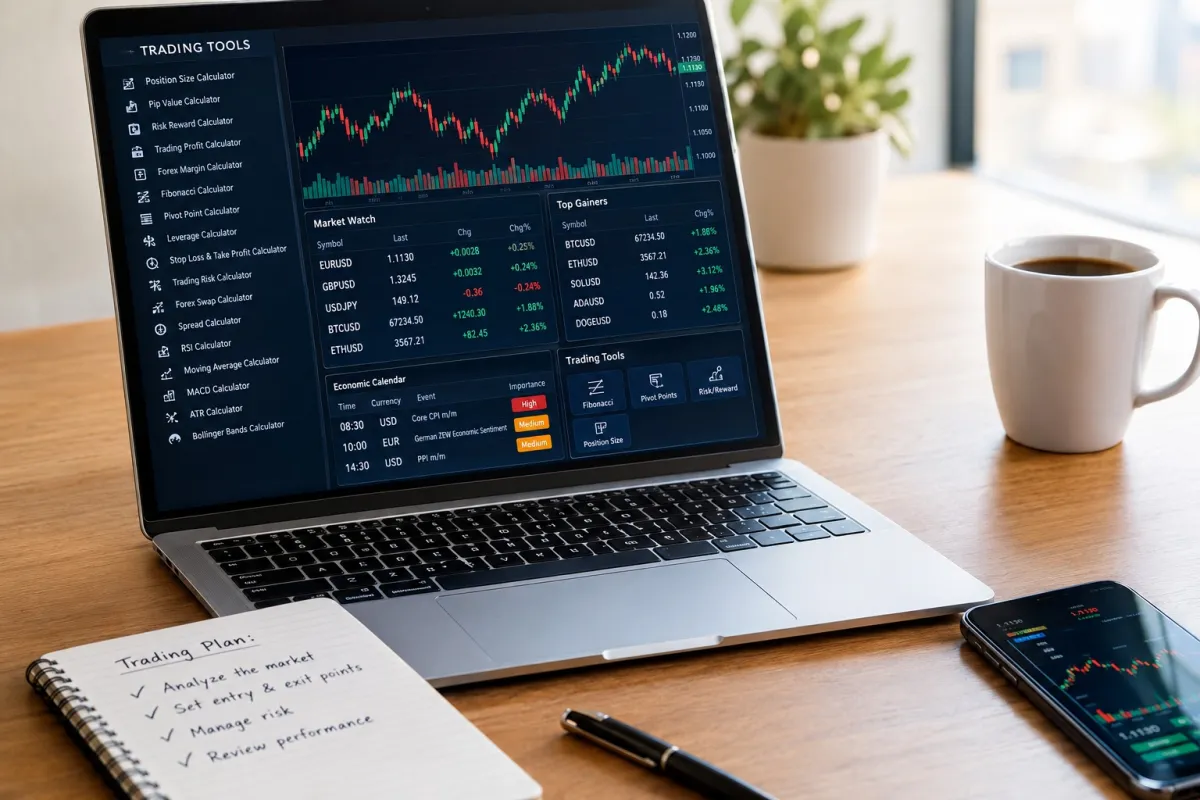
Trading financial markets requires more than identifying a potential buying or selling opportunity. Traders also need to manage risk, calculate position sizes, understand transaction costs, evaluate potential returns, and monitor their portfolios. The right trading tools can make these calculations easier, helping traders make more informed decisions based on their strategies and available capital.
VelixaKit offers a collection of free online trading tools for forex, gold, stocks, options, and cryptocurrency. Whether you need a position size calculator, pip calculator, risk-to-reward calculator, or crypto liquidation price calculator, these tools help you analyze trades without relying on complicated spreadsheets or manual calculations.
In this guide, you will learn how different trading calculators work, which tools are useful for specific markets, and how to incorporate them into a more disciplined trading routine.
What Are Trading Tools?
Trading tools are online calculators, analytical utilities, and tracking applications that help traders evaluate financial positions and manage their trading activities. They can calculate potential profits and losses, estimate required margin, identify technical indicator values, measure portfolio performance, and organize historical trades.
Some tools focus on risk management, while others help with technical analysis, derivatives pricing, or investment planning.
Common categories include:
- Risk management tools: Position size, stop loss, take profit, and risk-to-reward calculators.
- Forex trading tools: Pip value, margin, swap, spread, and market session calculators.
- Gold trading tools: XAUUSD profit and lot size calculators.
- Technical analysis tools: RSI, MACD, moving averages, Fibonacci levels, and pivot points.
- Crypto trading tools: Liquidation price, funding rate, dollar-cost averaging, and arbitrage calculators.
- Stock and options tools: Dividend yield, options profit, Black-Scholes pricing, and portfolio allocation calculators.
- Performance tracking tools: Trading journals, maximum drawdown calculators, and backtesting utilities.
Using these tools does not guarantee profitable trades. Their primary purpose is to improve calculation accuracy, make assumptions explicit, and help traders understand the risks associated with their decisions.
Explore Free Trading Tools on VelixaKit
VelixaKit brings together online trading calculators for different financial markets. Select a tool based on the calculation you need.
Position Sizing and Risk Management
Position sizing is one of the most important parts of a trading plan. It determines how much capital is exposed to a potential loss if a trade reaches its stop-loss level.
1. Position Size Calculator
Calculate an appropriate forex lot size, stock share quantity, or cryptocurrency position based on your account balance, risk percentage, entry price, and stop-loss level. Position sizing helps align each trade with a predefined risk limit.
2. Trading Risk Calculator
Estimate the potential cash risk of multiple open trades and compare total exposure with your account equity and personal risk limit. This is particularly useful when several positions could reach their stop losses simultaneously.
3. Risk Reward Calculator
Calculate the risk-to-reward ratio and the theoretical break-even win rate for a trade. These figures help you assess how much you could lose relative to your potential profit.
4. Stop Loss and Take Profit Calculator
Calculate stop-loss prices and take-profit targets using pip distances, percentage movements, or specified prices. You can also evaluate targets at different reward-to-risk ratios.
5. Trading Profit Calculator
Estimate the profit or loss of a forex, stock, or cryptocurrency trade. Depending on the inputs supported, you can account for price movements, position size, trading fees, and break-even prices.
6. Leverage Calculator
Understand your effective leverage by comparing the total value of your positions with your account equity. This can help you assess whether your exposure exceeds your intended limits.
7. Maximum Drawdown Calculator
Measure the largest decline from a previous peak in an account balance or price series. The calculator can also help you understand the gain required to recover from a loss.
8. Trading Compounding Calculator
Explore how repeated percentage gains, losses, and additional deposits may affect account growth over time. You can also calculate the return needed to recover from a drawdown.
Forex Trading Calculators
Forex traders frequently work with currency pairs, pip movements, leverage, spreads, and overnight financing costs. These calculators help estimate the financial impact of those variables.
9. Pip Value Calculator
Estimate the monetary value of a pip for a currency pair and position size. The value depends on the pair, trade size, and account currency, and may require a current exchange rate for conversion.
10. Forex Margin Calculator
Estimate the margin required to open a leveraged forex position. Margin requirements depend on the instrument, position value, leverage, and broker rules.
11. Forex Swap Calculator
Estimate overnight financing charges or credits for forex and gold positions. Depending on the method used, calculations may incorporate swap points, annual rates, and triple-swap days.
12. Spread Calculator
Calculate the estimated cost of the difference between a market's bid and ask prices. Understanding spreads can help you compare trading conditions and evaluate the cost of entering a position.
13. Forex Market Hours and Sessions
Review the Sydney, Tokyo, London, and New York trading sessions and their overlaps in your local time zone. Session overlaps can be important to traders monitoring liquidity and market activity, although actual conditions vary by currency pair and economic events.
Gold Trading Tools for XAUUSD
Gold attracts forex and CFD traders who want to analyze price movements in the precious metals market. However, the financial value of a gold position depends on contract specifications, lot size, and the broker's trading conditions.
14. Gold Profit Calculator (XAUUSD)
Estimate the profit or loss of a gold trade using opening and closing prices and position size. The tool can help translate a price movement into an estimated monetary result, including supported commission inputs.
15. Gold Lot Size Calculator
Estimate a suitable XAUUSD lot size based on your account risk and stop-loss distance. A correctly configured calculator should account for the gold contract size and round position size down when necessary to remain within the specified risk budget.
For example, a trader with a $2,000 account who chooses to risk 1% has a planned risk budget of $20. The appropriate gold position size depends on the stop-loss distance, contract specifications, and estimated transaction costs.
Explore both calculators before estimating your next gold trade.
Technical Analysis Calculators
Technical indicators help traders examine historical price behavior. They can support a trading strategy, but they do not independently predict future market movements.
16. Fibonacci Calculator
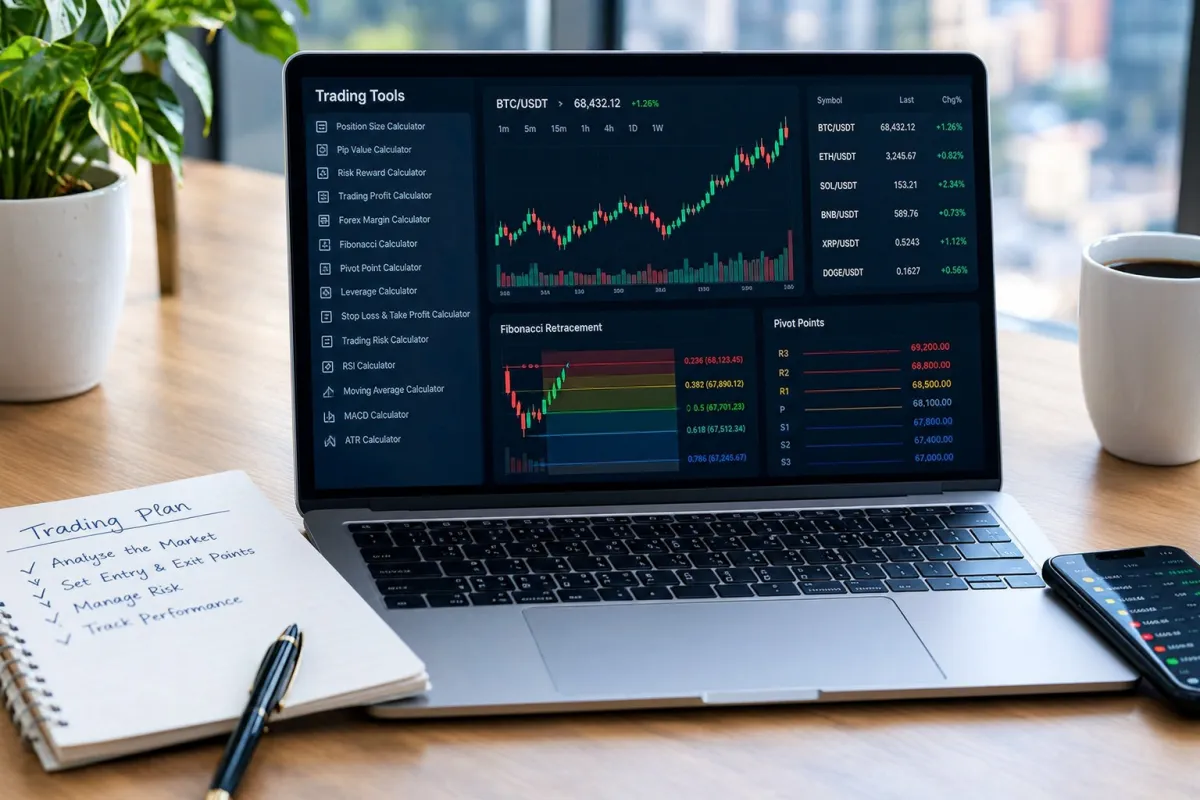
Calculate Fibonacci retracement and extension levels from a selected swing high and swing low. Traders commonly use these levels to examine possible pullback areas and price targets.
17. Pivot Point Calculator
Calculate support and resistance levels using classic, Fibonacci, Woodie, or Camarilla pivot methods. The results depend on the selected calculation method and the price data supplied.
18. RSI Calculator
Calculate the Relative Strength Index from historical prices. RSI is a momentum indicator commonly interpreted using reference levels such as 70 and 30, although those levels are not reliable reversal signals in every market condition.
19. Moving Average Calculator (SMA and EMA)
Calculate simple and exponential moving averages from a series of closing prices. Traders use moving averages to examine trends, compare price with an average, and test crossover strategies.
20. MACD Calculator
Calculate the Moving Average Convergence Divergence line, signal line, and histogram. The calculator supports analysis of momentum changes and potential moving-average crossovers.
21. ATR Calculator (Average True Range)
Calculate Average True Range using high, low, and closing prices. ATR measures historical volatility rather than market direction and can help traders evaluate volatility-adjusted stop distances.
22. Bollinger Bands Calculator
Calculate the upper, middle, and lower Bollinger Bands, along with %B and bandwidth. These measures help traders study price dispersion and volatility relative to a moving average.
Cryptocurrency Trading Calculators
Cryptocurrency markets operate across multiple exchanges and include spot trading, perpetual futures, mining, and automated investment strategies. Their fees, funding mechanisms, and contract rules can differ significantly.
23. Crypto DCA Calculator
Calculate the average purchase cost, total coins acquired, current value, and potential profit or loss from multiple cryptocurrency purchases. Dollar-cost averaging involves investing at predetermined intervals or amounts rather than making one large purchase.
24. Crypto Liquidation Price Calculator
Estimate the liquidation price of a leveraged long or short position in USDT-margined perpetual futures. Liquidation depends on factors such as leverage, maintenance margin, fees, and exchange-specific rules. Treat the result as an estimate unless all relevant exchange parameters are included.
25. Funding Rate Calculator
Estimate the funding payments you may pay or receive on a perpetual futures position. The calculation can help you evaluate the potential cost of holding a position over multiple funding intervals.
26. Crypto Arbitrage Calculator
Compare cryptocurrency prices across two exchanges and estimate the remaining profit after supported trading fees, withdrawal charges, and other costs. Price differences do not guarantee an executable arbitrage opportunity because prices, liquidity, and transfer times can change.
27. Bitcoin Mining Calculator
Estimate potential Bitcoin mining revenue and operating costs using inputs such as hashrate, electricity consumption, electricity prices, network difficulty, and Bitcoin price. Actual results also depend on pool fees, equipment efficiency, downtime, and changing network conditions.
28. Crypto Portfolio Tracker
Track cryptocurrency holdings using your own purchase and price information. Review portfolio value, estimated profit or loss, and the percentage represented by each asset. Check the tool's storage behavior and keep your records backed up when needed.
Stock, Options, and Portfolio Calculators
Investors in stocks and listed options need tools that address income, allocation, derivatives pricing, and potential payoff scenarios.
29. Average Price Calculator
Calculate the average purchase price of shares or cryptocurrency bought at different prices. You can also estimate how an additional purchase would change your average cost. Averaging down increases exposure and does not guarantee recovery.
30. Dividend Yield Calculator
Calculate dividend yield and estimate potential dividend income by payment period. Depending on the inputs, you can also examine yield on cost and the effect of taxes. Remember that dividends can change and share prices can fall.
31. Options Profit Calculator
Estimate the potential payoff of options strategies such as calls, puts, spreads, straddles, and iron condors at expiration. Review break-even prices and maximum profit or loss under the selected assumptions.
32. Black-Scholes Calculator
Estimate European call and put option values using the Black-Scholes model. The calculator can also report Greeks such as delta, gamma, vega, theta, and rho, which describe how an option's theoretical value responds to changes in selected variables.
The model relies on assumptions about volatility, interest rates, and other factors. Actual option prices may differ from theoretical values.
33. Covered Call Calculator
Evaluate a covered call position consisting of shares and a call option sold against those shares. Compare possible outcomes if the shares are called away or remain below the strike price at expiration.
34. Put-Call Ratio Calculator
Calculate the ratio of put options to call options using trading volume or open interest. Traders may use this ratio to examine market sentiment, but its interpretation depends on the underlying market, data source, and context.
35. Portfolio Allocation Calculator
Calculate the current weight of each holding and estimate the purchases or sales needed to reach target allocations. This can help investors review diversification and rebalance a portfolio according to their chosen plan.
Trading Performance and Strategy Testing
Good trading decisions require more than individual entry and exit calculations. Performance tracking helps traders understand how their strategies behave across multiple trades.
36. Trading Journal
Record completed trades and review statistics such as net profit, win rate, profit factor, expectancy, R-multiples, winning and losing streaks, and drawdown. CSV export can help you preserve records and conduct additional analysis.
37. Backtesting Calculator
Test selected moving-average crossover, RSI, or MACD rules against historical price data supplied through a CSV file. Supported settings may include fees, short positions, drawdown, and individual trade results.
Backtesting can reveal how a rule performed on historical data, but it cannot establish that the same strategy will be profitable in the future. Results depend on data quality, execution assumptions, and the risk of overfitting.
How to Choose the Right Trading Calculator
The best trading calculator depends on the market you trade and the question you need to answer.
| Your trading goal | Recommended tool |
|---|---|
| Calculate forex lot size | Position Size Calculator |
| Estimate the monetary value of a pip | Pip Value Calculator |
| Evaluate potential reward against risk | Risk Reward Calculator |
| Calculate gold position size | Gold Lot Size Calculator |
| Estimate margin for leveraged forex | Forex Margin Calculator |
| Calculate a crypto futures liquidation price | Crypto Liquidation Price Calculator |
| Analyze momentum and trends | RSI, MACD, or Moving Average Calculator |
| Estimate options payoff at expiration | Options Profit Calculator |
| Track trade statistics | Trading Journal |
| Test a rules-based strategy | Backtesting Calculator |
| Review portfolio weights | Portfolio Allocation Calculator |
If you trade multiple markets, consider using a consistent workflow for position sizing, transaction costs, and risk evaluation. The inputs and contract specifications must still match the particular instrument and broker.
How to Use Trading Tools Effectively
Online trading calculators are most useful when they form part of a consistent decision-making process.
1. Define Your Trading Budget
Start with your account equity and decide how much you are willing to risk on an individual trade. A percentage-based risk budget can help you compare positions of different sizes.
For example, a 1% risk budget on a $5,000 account equals $50. This is a planning limit, not a guarantee that the eventual loss will be capped at exactly $50. Slippage, gaps, commissions, and execution conditions can increase losses.
2. Identify Your Entry and Stop-Loss Prices
Determine the entry price and the price at which your trade thesis would no longer be valid. Use the stop-loss distance to calculate a position size that fits your risk budget.
Avoid choosing a stop solely to obtain a larger position. The stop should reflect your trading method and the instrument's price behavior.
3. Estimate the Position Size
Enter the relevant account balance, risk amount, entry price, and stop-loss price into a suitable position size calculator.
For forex and gold, verify the contract size, pip or tick value, account currency, and lot increment. For stocks and crypto, account for units, fees, and any applicable leverage or contract multiplier.
4. Check Transaction Costs and Margin
Review spreads, commissions, financing charges, and required margin before opening a position. A trade with an attractive theoretical reward-to-risk ratio may become less attractive after costs.
For leveraged products, remember that margin is collateral required to maintain exposure, not the maximum amount you can lose.
5. Evaluate the Potential Reward
Use a risk-reward calculator to compare your planned stop-loss and take-profit levels. Consider whether the proposed trade makes sense within your strategy and whether the estimated reward compensates for the risks and costs involved.
A high reward-to-risk ratio does not necessarily indicate a good trade if the probability of achieving the target is low.
6. Record and Review Your Results
Use a trading journal to document your entry, exit, position size, costs, and reasons for taking the trade. Review the results over a meaningful sample of trades rather than drawing conclusions from a single win or loss.
When appropriate, test your rules against historical data before risking real money. Keep in mind that historical performance is not a reliable guarantee of future results.
Important Trading Formulas
Understanding the basic mathematics behind trading calculators makes it easier to check results and recognize incorrect inputs.
Position Size Based on Risk
For instruments with a straightforward unit-based payoff:
Position size = Risk budget ÷ Estimated loss per unit at the stop.
For example, if you plan to risk $50 and the estimated loss at the stop is $2 per share, the calculated position is 25 shares before accounting for additional costs or other constraints.
Risk-to-Reward Ratio
Risk-to-reward ratio = Potential loss ÷ Potential profit.
If the planned loss is $100 and the potential profit is $200, the ratio is 1:2, meaning you are risking $1 for a potential $2 gain.
Dividend Yield
Dividend yield = Annual dividend per share ÷ Current share price × 100.
If the annual dividend is $2 and the share price is $40, the indicated dividend yield is 5%, assuming the dividend remains unchanged.
Maximum Drawdown
Maximum drawdown = (Peak account value − Subsequent trough value) ÷ Peak account value × 100.
If an account declines from $10,000 to $8,000, the drawdown is 20%. Recovering from a 20% loss requires a 25% gain on the remaining $8,000 to return to $10,000.
These simplified formulas are useful for understanding the calculations. Some instruments require additional conversions, contract multipliers, financing charges, or exchange-specific rules.
Trading Risk Management: What Calculators Cannot Do
Trading tools can improve calculation accuracy, but they cannot remove market risk or determine whether a trade is appropriate for your financial circumstances.
Keep these limitations in mind:
- Leverage magnifies exposure. Small price changes can create large gains or losses relative to your initial margin.
- Stops are not guaranteed execution prices. Gaps and slippage can cause a position to close at a different price.
- Costs affect performance. Spreads, commissions, funding payments, and overnight financing can reduce returns.
- Market conditions change. A technical indicator or historical strategy may behave differently in a new environment.
- Data quality matters. Incorrect price histories, missing candles, and inconsistent time zones can distort calculations.
- Backtests have limitations. Historical results may not reflect real-world liquidity, execution delays, or future market behavior.
- Diversification does not eliminate risk. Assets that appear different may become correlated during periods of market stress.
Use calculator outputs as estimates based on the information provided, and verify important contract details with your broker or exchange.
Trusted Resources for Learning About Trading
For additional information on market mechanics, derivatives, and investment risk, consult established financial and educational resources.
- U.S. Securities and Exchange Commission (SEC) — Investor education and information about investment risks.
- Commodity Futures Trading Commission (CFTC) — Information about futures, derivatives, and commodity-market risks.
- CME Group Education — Educational materials on futures, options, contract specifications, and market mechanics.
- FINRA — Resources for understanding brokerage accounts, investment products, and trading risks.
- Options Industry Council — Educational resources covering options strategies, pricing, and risk.
Use these resources to build your understanding and verify instrument-specific details rather than relying exclusively on a calculator's output.
Frequently Asked Questions About Trading Tools
What are the best free trading tools for beginners?
Useful starting points include a position size calculator, risk-reward calculator, trading profit calculator, and trading journal. These tools help beginners understand position exposure, potential losses, transaction costs, and trading performance before moving to more advanced analysis.
Which trading calculator is best for forex?
The Position Size Calculator, Pip Value Calculator, Forex Margin Calculator, and Spread Calculator are useful for common forex calculations. The appropriate tool depends on whether you need to estimate position size, pip value, margin, or transaction costs.
Is there a trading calculator for gold (XAUUSD)?
Yes. The Gold Profit Calculator estimates the profit or loss of a gold trade, while the Gold Lot Size Calculator helps estimate position size from a risk budget and stop-loss distance.
How do I calculate the correct lot size?
First, determine your account risk budget. Next, calculate the potential loss per lot at your stop-loss price using the instrument's contract specifications and applicable currency conversion. Divide your risk budget by that loss per lot, then adjust for lot increments, costs, and broker restrictions.
Are online trading calculators accurate?
They can produce accurate mathematical estimates when the inputs, formulas, and instrument specifications are correct. However, results may differ from actual trading outcomes because of changing exchange rates, slippage, fees, funding, contract rules, and execution conditions.
Can I use trading tools for cryptocurrency?
Yes. Cryptocurrency traders can use DCA, liquidation price, funding rate, arbitrage, and portfolio tracking calculators. For leveraged derivatives, verify the exchange's maintenance margin, funding schedule, fee structure, and liquidation rules.
What is the difference between a trading calculator and a trading platform?
A trading calculator performs a specific calculation or analysis. A trading platform typically provides order execution, market data, charts, and account management. A calculator may complement a trading platform, but it does not necessarily provide live prices or execute trades.
Do trading calculators guarantee profits?
No. Calculators help evaluate potential outcomes and manage calculations, but they cannot predict markets with certainty or guarantee a profit. Every trading strategy involves risk, and leveraged trading can result in substantial losses.
Start Using Free Trading Tools on VelixaKit
Better trading decisions begin with understanding your numbers. Whether you trade forex, gold, stocks, options, or cryptocurrency, the right calculators can help you estimate position sizes, evaluate risk, understand transaction costs, and review performance more systematically.
Explore the VelixaKit Trading Tools collection and choose the calculators that match your trading strategy. Start with position sizing and risk management, then add technical analysis and performance tracking as your needs evolve.
This article is for educational and informational purposes only. It is not financial, investment, tax, or trading advice. Trading involves risk, including the potential loss of your invested capital. Leveraged products can result in losses greater than expected. Always verify calculations and instrument specifications before making financial decisions.